
Bacteriophages and the Gut Microbiome
Bacteriophages are among the most fascinating components of the human microbiome. Although they are found everywhere around us, many people know very little about them.
Yet bacteriophages likely play a central role within microbial ecosystems¹.
But what exactly are bacteriophages? And why are modern microbiome researchers becoming increasingly interested in these tiny biological structures?
What Are Bacteriophages?
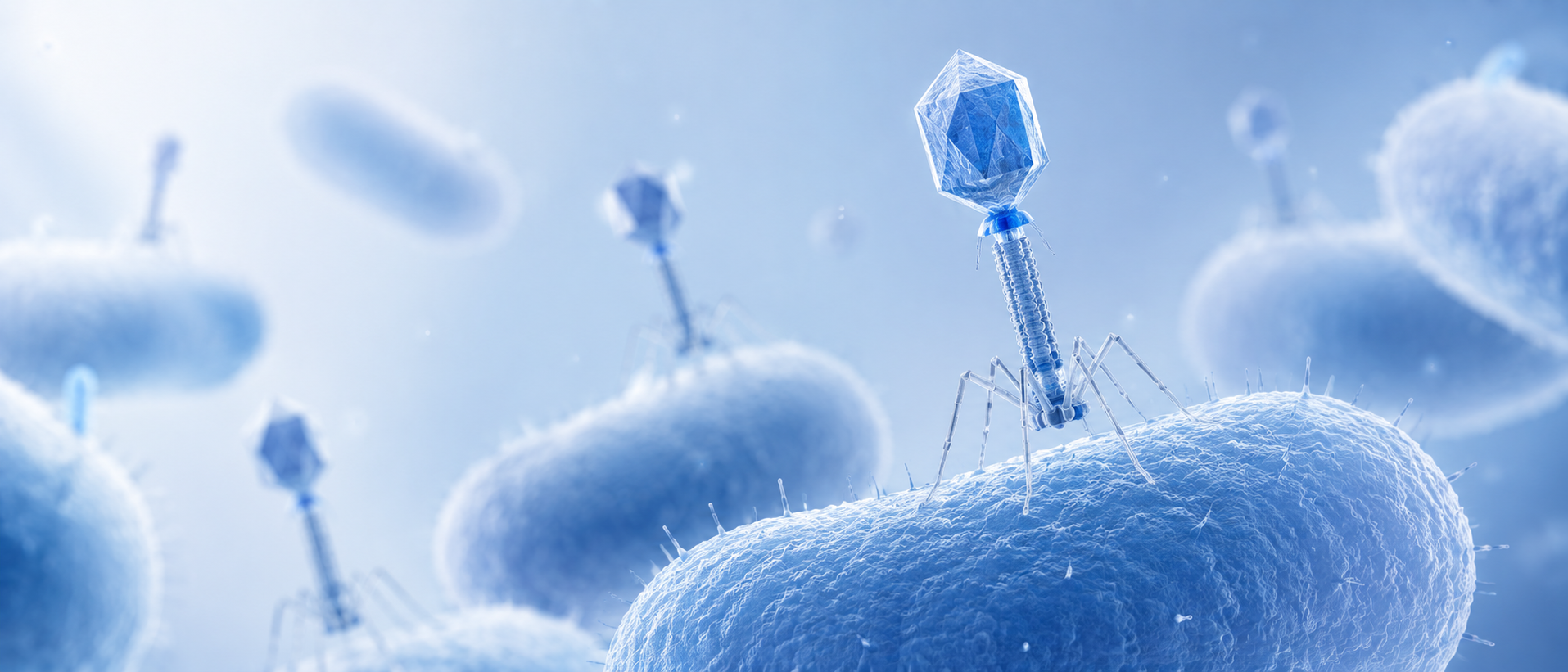
Bacteriophages, often simply called phages, are viruses that specifically infect bacteria².
The term consists of:
- Bacterium
- “Phagein,” the Greek word for “to eat”
Phages can attach themselves to specific bacteria and inject their genetic material into the bacterial cell.
Particularly fascinating:
Bacteriophages are considered the most abundant biological entities on our planet³.
Scientists estimate that more than 10³¹ phages exist worldwide.
They are found everywhere bacteria exist:
- In the gut
- In soil
- In oceans
- In food
- In wastewater
- On the skin
The Gut Phageome
The human gut microbiome does not consist only of bacteria.
It also includes:
- Fungi
- Viruses
- Archaea
- Bacteriophages
The collection of phages within the gut microbiome is referred to as the phageome⁴.
Modern research increasingly shows that phages may influence the composition and dynamics of bacterial communities⁵.
As a result, they may play an important role in:
- Microbial stability
- Bacterial diversity
- Resistance development
- Microbial communication
Why Are Researchers Interested in Bacteriophages?
Phages are highly specific.
Many phages can infect only certain bacterial groups or even individual bacterial strains⁶.
This is exactly why they are considered highly interesting for modern microbiome research and future microbiological applications.
Areas currently being intensively studied include:
- Phages and antibiotic resistance
- Phages within the gut microbiome
- Phages in the environment and wastewater
- Phages as potential biological tools
- Phages and bacterial ecosystems
Research in this field is evolving extremely rapidly.
Bacteriophages and Antibiotic Resistance
Antibiotic resistance is now considered one of the greatest global health challenges⁷.
At the same time, scientists are increasingly investigating the role phages may play within so-called resistomes.
Particularly interesting:
Phages can sometimes transfer genetic material between bacteria⁸.
As a result, they may contribute to microbial evolutionary processes.
Modern metagenomics is therefore intensively studying the relationships between:
- Bacteriophages
- Resistance genes
- Microbial communities
- Environmental microbiology
Phages in the Environment and Wastewater
Bacteriophages are found in extremely high numbers within wastewater systems⁹.
This is one reason why they are becoming increasingly important within modern environmental microbiology.
Wastewater contains highly complex microbial communities consisting of:
- Bacteria
- Viruses
- Fungi
- Resistance genes
- Mobile genetic elements
Research suggests that phages within such systems may influence the dynamics of microbial communities¹⁰.
This is also one of the areas addressed by our research at Bactera.
Our Research at Bactera
At Bactera, we are deeply involved in modern shotgun metagenomics and microbial ecosystem research.
A particular focus of our work includes:
- Bacteriophages
- Resistance genes
- Environmental microbiology
- Wastewater microbiomes
- Microbial diversity
As part of our research, we analyze sequencing data from environmental and wastewater samples to better understand bacterial and viral communities.
Our goal is to use modern shotgun sequencing and bioinformatics to gain deeper insights into highly complex microbial ecosystems.
You can learn more about our research at Bactera Research
Phages and the Future of Microbiome Research
Modern microbiome science is increasingly evolving from pure “bacterial research” toward the analysis of complete microbial networks.
This now includes:
- Fungi
- Viruses
- Phages
- Resistance genes
- Functional microbial interactions
Many scientists believe that phages will play an increasingly important role in microbiome research in the future¹³.
Particularly exciting is the question of how phages may regulate and influence bacterial communities.
Conclusion
Bacteriophages are among the most abundant biological entities on Earth and likely play a central role within microbial ecosystems.
Modern research is intensively investigating how phages interact with bacteria, resistance genes, and microbial networks.
Thanks to modern shotgun sequencing technologies, viral components of the microbiome can now be analyzed far more comprehensively than just a few years ago.
This is exactly why phage research is currently becoming one of the most exciting areas of modern microbiome science.
Scientific References
- Sutton TDS, Hill C. Gut bacteriophage communities in human health and disease. Viruses. 2021.
- Bacteriophage overview and biology.
- Clokie MRJ, Millard AD, Letarov AV et al. Phages in nature. Bacteriophage. 2021.
- The human gut phageome and microbiome interactions. Frontiers in Cellular and Infection Microbiology. 2021.
- Shkoporov AN, Hill C. Bacteriophages of the human gut. Cell Host & Microbe. 2021.
- Hsu BB, Gibson TE, Yeliseyev V et al. Dynamic modulation of the gut microbiota by bacteriophages. Cell Host & Microbe. 2022.
- World Health Organization. Antimicrobial resistance global report. 2023.
- Exploring the contribution of bacteriophages to antibiotic resistance. Environmental Pollution. 2021.
- Bacteriophages in sewage abundance roles and applications. 2022.
- Bacteriophages in biological wastewater treatment systems. Frontiers in Microbiology. 2021.
- Quince C, Walker AW, Simpson JT et al. Shotgun metagenomics from sampling to analysis. Nature Biotechnology. 2021.
- PhaBOX and modern phage metagenomics approaches. 2023.
- Sustainable diversity of phage bacteria systems. 2023.
Share:
Fungi in the Gut: How Candida Influence the Gut Microbiome and Gut Flora
What Is the Gut Virome? Viruses, Phages and the Human Microbiome Explained