

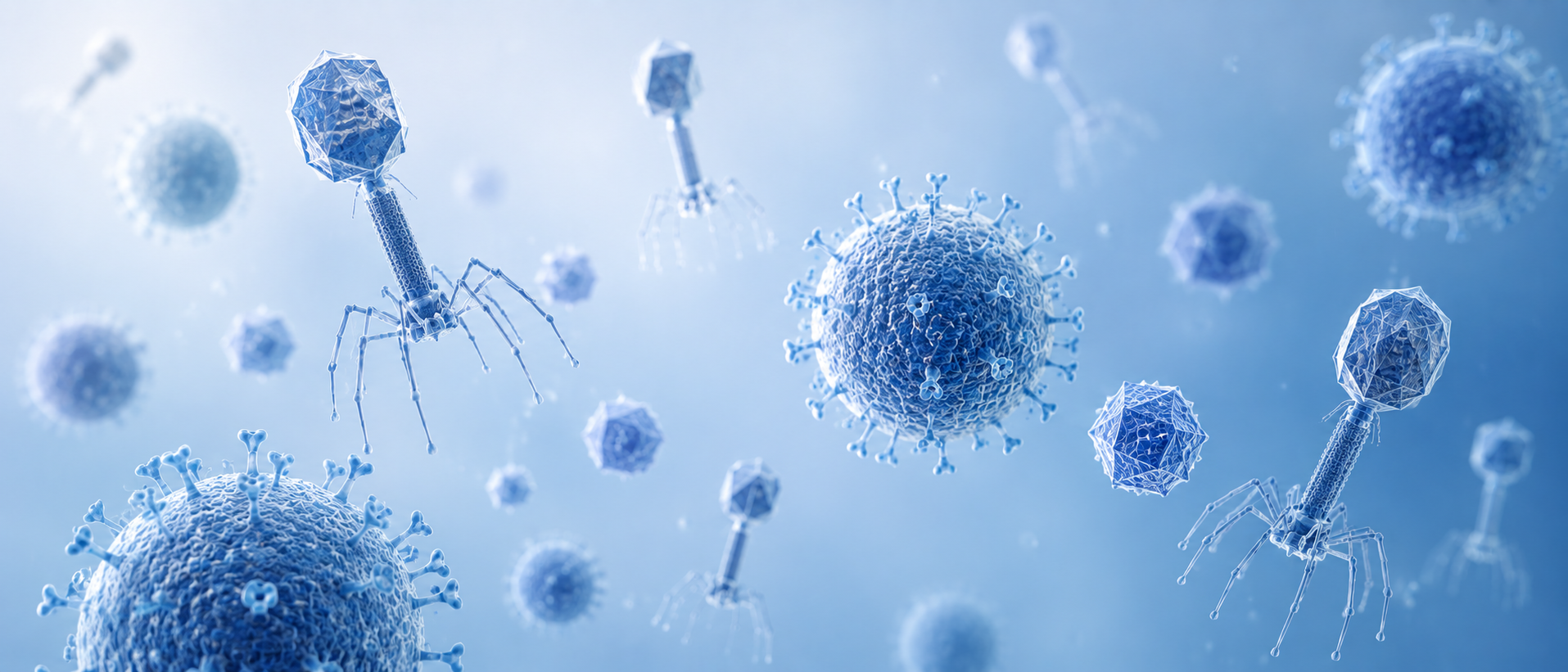
Virome & Gut Microbiome
When people talk about the gut microbiome, most first think about bacteria. In reality, however, the human microbiome consists of far more than just bacterial microorganisms¹.
The gut ecosystem also includes:
- Bacteria
- Fungi
- Viruses
- Bacteriophages
- Archaea
The collection of viruses within the microbiome is referred to as the virome².
In recent years, research has begun to understand that viruses may also play an important role within microbial ecosystems.
What Is the Virome?
The virome includes all viral components within a microbial community³.
This includes:
- Viruses that infect human cells
- Bacteriophages that infect bacteria
- Viral genetic fragments within the microbiome
Particularly interesting:
The gut virome is extremely complex and highly individual. Many viral sequences within the human gut remain scientifically uncharacterized to this day⁴.
The Gut Microbiome Consists of More Than Just Bacteria
Modern microbiome research increasingly shows that bacterial communities closely interact with viral components⁵.
Bacteriophages in particular may play an important role in:
- Microbial stability
- Bacterial diversity
- Resistance dynamics
- Microbial interactions
As a result, the virome is becoming an increasingly important area of modern microbiome research.
DNA Viruses and RNA Viruses
Viruses fundamentally differ in their genetic structure.
Some viruses contain:
- DNA as genetic material
- RNA as genetic material
This distinction is especially important for modern sequencing technologies.
At Bactera, we use shotgun DNA sequencing. Therefore, we primarily analyze DNA-based components of the microbiome⁶.
Important to understand:
Many well-known gut viruses are RNA viruses. These are only partially detected, or not detected at all, through pure DNA sequencing.
This means:
A DNA-based microbiome test does not represent the complete human virome.
Which Viral Components Can Be Analyzed?
Using modern shotgun DNA sequencing, various DNA-based viral components can be analyzed⁷.
These include, for example:
- Certain adenoviruses
- Bacteriophage-associated sequences
- DNA viruses within microbial communities
Adenoviruses are among the best-known DNA viruses in humans.
Some adenovirus types may be associated with gastrointestinal symptoms⁸.
Importantly:
The detection of viral DNA does not automatically indicate an active infection or disease.
The results are intended for the scientific and educational interpretation of microbial patterns.
Why Is the Virome Scientifically Interesting?
The virome is currently one of the fastest-growing research areas within microbiome science⁹.
Scientists are intensively investigating:
- How viruses influence bacterial communities
- How phages interact with the resistome
- How the virome differs between individuals
- How diet and environmental factors may influence the virome
Particularly fascinating:
Many viral sequences within the human gut remain scientifically unknown to this day¹⁰.
Our Approach at Bactera
At Bactera, we use modern shotgun metagenomics and scientific bioinformatics.
With our Microbiome 360° approach, we analyze:
| Area | What Is Analyzed |
|---|---|
| Bacterial Diversity | Alpha diversity and microbial stability |
| Resistance Genes | Resistance-associated genetic patterns |
| Fungi & Yeasts | Various components of the mycobiome |
| Virome | DNA-based viral sequences |
| Phages | Bacteriophage-associated components |
Important to understand:
Because we use DNA sequencing, many RNA viruses of the gut are not fully detected.
The analysis is intended for the scientific and educational interpretation of microbial patterns and does not replace medical viral diagnostics.
Conclusion
The human gut microbiome consists not only of bacteria, but also of a highly complex diversity of viral components.
The virome is now becoming one of the most exciting areas of modern microbiome research.
Using modern shotgun DNA sequencing, certain DNA-based viral components, including adenoviruses and bacteriophage-associated sequences, can be analyzed.
At the same time, it is important to understand that many gut viruses are RNA-based viruses and are therefore only partially detected through DNA sequencing alone.
This is exactly why virome research is currently evolving so dynamically and continuously providing new insights into the human microbiome.
Scientific References
- Almeida A, Nayfach S, Boland M et al. A unified catalog of reference genomes from the human gut microbiome. Nature Biotechnology. 2021.
- Shkoporov AN, Hill C. Bacteriophages of the human gut. Cell Host & Microbe. 2021.
- Gregory AC, Zablocki O, Howell A et al. The human gut virome database. Cell Host & Microbe. 2022.
- Camarillo Guerrero LF, Almeida A, Rangel P et al. Massive expansion of human gut bacteriophage diversity. Cell. 2021.
- Sutton TDS, Hill C. Gut bacteriophage communities in human health and disease. Viruses. 2021.
- Quince C, Walker AW, Simpson JT et al. Shotgun metagenomics from sampling to analysis. Nature Biotechnology. 2021.
- Aggarwala V, Liang G, Bushman FD. Viral communities of the human gut. Annual Review of Virology. 2021.
- Lynch JP, Kajon AE. Adenovirus epidemiology pathogenesis and clinical disease. Journal of Clinical Microbiology. 2021.
- Liang G, Bushman FD. The human virome in health and disease. Nature Reviews Microbiology. 2021.
- Gregory AC, Zayed AA, Conceição Neto N et al. Marine DNA viral macro and microdiversity from pole to pole. Cell. 2021.
- Knight R, Vrbanac A, Taylor BC et al. Best practices for analysing microbiomes. Nature Reviews Microbiology. 2022.
Share:
Bacteriophages and the Gut Microbiome: Understanding the Human Gut Phageome
Functional Microbiome Analysis: How Shotgun Sequencing Reveals Functional Patterns in the Gut Microbiome