

Oral microbiome test for home use: oral flora analysis at species level
Beyond a simple germ test. Your entire oral flora decoded & analyzed.
With Microbiome 360° Oral, Bactera offers one of the most advanced oral flora analyses available. A dental germ test counts a few indicator germs and a 16S test reads only single genes. We decode the entire DNA of your saliva sample using shotgun sequencing and identify bacteria, archaea and fungi from the whole mouth down to species level.
Your sample is analyzed in-house in Germany, using advanced bioinformatics and the highest scientific standards. The result is a comprehensive view of your oral microbiome: Oral Health Score, gum and cavity pressure, breath and other key areas of your oral health.
One saliva sample. 360° analysis. Complete DNA. Deeper insights.
- Oral Health Score (0 to 100) with five components
- Microbial pattern and community type
- Diversity, distance from healthy reference, dysbiosis balance
- Core 5 oral microorganisms
- Functional potential: nitrate reduction and pH resilience
- Functional pressure: cariogenic, periodontal, sulfur compounds
- Periodontal (gum) pressure
- Cariogenic (cavity) pressure
- Breath and sulfur pressure (halitosis)
- Profile of 36 key organisms in 8 groups
- Fungal panel (4 yeasts)
- Clinically relevant organisms, 9 reported individually
- Full list of your microorganisms and raw data to download
- Free report upgrades as new analyses become available
Get notified when this product becomes available.
One email as soon as Microbiome 360° Oral can be ordered. No launch date has been set yet.
Please enter a valid email address.
Thank you, you are on the list.We will send you one email as soon as Microbiome 360° Oral can be ordered.
Product: Microbiome 360° Oral
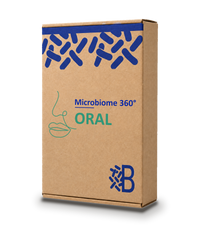
Microbiome 360° Oral is still in development
The analysis and the report are not in their final form yet and may still change until release. The following sections show how the report could look and which analyses we perform.
One saliva sample, the whole oral community
The established test in Germany is the dental germ test: a PCR panel for a handful of predefined marker germs, usually taken from a single gum pocket. We read the entire DNA of your saliva sample, and saliva covers the whole mouth.
Shotgun metagenomics identifies what is actually there, down to the species, including the four yeasts of the fungal panel, all in the same sequencing run.
A pocket sample describes one site on one tooth. Saliva pools the entire mouth, which is what makes an ecological reading of the system possible.
Nitrate reduction, alkali production from arginine and urea, acid tolerance and sulfur pathways are read from the DNA itself, together with the organisms behind them.
FASTQ files and raw abundances remain available for download, and whenever a new analysis becomes available your existing sequencing data is re-analysed and your report upgraded, free of charge and without a new saliva sample.
What you get: a report that explains your oral flora instead of just counting
For every value you see the comparison with the healthy salivary reference, what it means for you and what to do next. Use the report interactively in the portal or download it.
- Interactive in the portalDesktop and mobile, available at any time at my.bactera.de. You can download the report and share it, for example with your dentist.
- Highest scientific standardVery deep analysis with 25 million paired-end reads per sample. On request we increase the sequencing depth: contact us before ordering via our contact page or info@bactera.de.
- Raw data includedFASTQ files and abundance tables to download
What Microbiome 360° Oral covers
Ten analysis areas from one saliva sample, all in one report.
Oral Health Score
A single measure from 0 to 100 of how closely your salivary ecosystem resembles our healthy reference: not an average of separate risks, but a biologically weighted picture of the whole community.
Your score of 52 is pulled down mainly by an elevated periodontal (gum-associated) microbial pattern and a reduced beneficial-function capacity (low nitrate reduction). Your symbiosis balance and cariogenic axis are closer to typical, which is why the score sits in the middle rather than the bottom of the range. This is an actionable result: the drivers are exactly the things a dental visit and the action plan can address.
Oral ecology
Whole-community measures. Unlike the gut, a higher diversity in the mouth is not automatically healthier; we read your community by its similarity to healthy people.
Core 5 oral microorganisms
Five organisms that together read out the health of your salivary ecosystem: three health anchors and two pressure markers, chosen from the evidence.
Functional potential
Shotgun sequencing reads genes, not just names. That is how we estimate what your community is equipped to do: genetic potentials.
Periodontal pressure
How closely your salivary community resembles the profiles described in gum disease, as one continuous pressure value.
Your saliva carries an elevated pattern of organisms associated with moderate-to-severe gum disease, alongside reduced health-associated commensals. This is the clearest signal in your report. Recommended next step: a periodontal check-up (gum probing) with your dentist.
Cariogenic pressure
How closely your salivary community resembles the profiles described in cavities: cariogenic organisms, acid-producing potential and the protective streptococci, as one continuous pressure value.
Your cavity-associated pressure is only mild to moderate: S. mutans is low and your protective sanguinis-group streptococci are intact. This is a relative strength in your profile.
Breath and sulfur pressure
How closely your salivary community resembles the profiles described in bad breath: sulfur-producing organisms and the genes for volatile sulfur compounds, as one continuous pressure value.
mgl)An elevated potential for odorous sulfur gases, leaning toward the methyl-mercaptan / gum-associated type. This overlaps directly with your periodontal pattern: improving gum health should help breath.
Key microorganism profile: 36 organisms in eight groups
Thirty-six organisms grouped by their role in the mouth, plus a fungal panel. Each dot is coloured by the band it falls into.
Fungal panel & clinically relevant organisms
Fungi are a small, widely varying part of the oral flora, so we report four yeasts as presence. Nine organisms of specific clinical interest additionally appear individually, with abundance, percentile and interpretation.
| Organism | Abundance | Result | Note |
|---|---|---|---|
| Porphyromonas gingivalis | 0.27% | P92 · High | Keystone gum-disease organism; well above healthy range |
| Tannerella forsythia | 0.15% | P80 · High | Red-complex gum organism; elevated |
| Treponema denticola | 0.04% | P58 · Typical | Red-complex; modestly detected |
| Filifactor alocis | 0.22% | P76 · High | Emerging gum-disease organism; elevated |
| Aggregatibacter actinomycetemcomitans | Not detected | Aggressive-periodontitis organism; absent (reassuring) | |
| Streptococcus mutans | 0.05% | P44 · Low | Classic cavity organism; low |
| Streptococcus sobrinus | Not detected | Cavity organism; absent | |
| Scardovia wiggsiae | Not detected | Cavity organism; absent | |
| Candida albicans | detected | present | Common oral yeast; presence is normal |
Your detection pattern reinforces the report's main theme: the gum-associated organisms (P. gingivalis, T. forsythia, F. alocis) are elevated, while the cavity organisms (S. mutans, S. sobrinus, Scardovia) are low or absent. A dental gum check is the sensible next step.
Full list of your microorganisms & free report upgrades
You receive the complete list of every microorganism identified in your sample (187 species in the example), together with the raw data. And your report does not stand still: we continuously add new analyses, markers and insights, and whenever a new analysis becomes available your existing sequencing data is re-analysed and your report upgraded, free of charge and without a new saliva sample.
Gums, cavities and breath: three pressure patterns from one saliva sample
For gums, cavities and breath, we show how closely your salivary community resembles the profiles described for common oral conditions. Each pattern is one continuous pressure value, with the organisms behind it.
Periodontal pressure
9 markers- Porphyromonas gingivalis
- Tannerella forsythia
- Fusobacterium nucleatum
- Treponema denticola
- Filifactor alocis
- Fretibacterium fastidiosum
- Parvimonas micra
- ↓ Rothia (health-associated)
- ↓ Neisseria (health-associated)
Cariogenic pressure
5 markers- Streptococcus mutans
- Veillonella
- Acidogenic potential
- ↑ S. sanguinis group (protective)
- Arginine-alkali capacity
Breath/sulfur pressure
6 markers- Fusobacterium nucleatum
- Porphyromonas gingivalis
- Prevotella
- Solobacterium moorei
- Treponema denticola
- Methyl-mercaptan genes (mgl)
Each pressure pattern shows one continuous pressure value on an axis from lower to higher pressure, the organisms behind it as chips and an interpretation in a few sentences, with the next step.
Your saliva carries an elevated pattern of organisms associated with moderate-to-severe gum disease, alongside reduced health-associated commensals. This is the clearest signal in your report. Recommended next step: a periodontal check-up (gum probing) with your dentist.
What your oral flora is genetically equipped to do: five panels with percentile
Here the question shifts from which organisms live in your mouth to what they can actually do. Shotgun sequencing reads genes, not just names, so we can estimate what your oral flora is genetically equipped to do. Each panel names the organisms and genes it is built from.
Proteolytic / Periodontal Potential Pressure
P83HighProtein-degrading, iron/heme-scavenging capacity that thrives in inflamed gums.
Elevated (P83), tracking your elevated P. gingivalis, T. forsythia and F. nucleatum.
Built fromrgp/kgp)heme uptakeamino-acid fermentationred-complex taxaCapacity to convert dietary nitrate to nitrite, supporting nitric-oxide signalling and a higher mouth pH that suppresses cavity and gum organisms.
Low (P24), a direct consequence of your low Rothia and Neisseria. This is your most improvable lever.
Built fromnarG/napA genesThe balance between acid-producing and acid-neutralising (arginine/urea) capacity.
Slightly acid-leaning but not extreme: your intact sanguinis-group streptococci help here.
Built fromarcABC / ureABC alkali genesacidogenic machineryAcid-producing and acid-tolerating gene capacity.
Mild-to-moderate, consistent with low S. mutans.
Built fromCapacity to make odorous sulfur gases from proteins.
Elevated (P74), leaning toward the methyl-mercaptan/gum type.
Built frommgl / hly / mccB genesSolobacteriumFusobacteriumPrevotellaPorphyromonasFive organisms that sum up your salivary ecosystem
We picked five organisms with strong evidence behind them: three health anchors and two pressure markers. Together they show the state of your salivary ecosystem at a glance.
Sample illustration from the reportIn addition, 31 further key organisms in eight groups (health commensals and nitrate reducers, commensal streptococci, established and emerging periodontal markers, cariogenic, halitosis and bridging organisms) plus the fungal panel: each with abundance, percentile versus the healthy salivary reference and interpretation.
What we report organism by organism
We also report nine organisms of specific clinical interest, a fungal panel with four yeasts and 36 key organisms in eight ecological groups. All from the same saliva sample, at no extra cost.
Nine organisms are reported individually, each with abundance, percentile against the healthy salivary reference and an interpretation.
Keystone organism of gum disease, one of the red-complex organisms.
Red-complex organism, reported together with the periodontal pattern.
The third red-complex organism of the classic gum-disease trio.
Emerging gum-disease marker that a germ panel usually leaves out.
Associated with aggressive forms of periodontitis.
The classic cavity organism, reported with its abundance.
Second cavity organism, often found alongside S. mutans.
Cavity organism linked with early childhood and severe caries.
The most common oral yeast, reported as present or absent.
- Abundance in percent of your community.
- Percentile against the healthy salivary reference.
- A short interpretation per organism.
- A next step where one is useful, for example a periodontal check.
The pattern across these nine organisms is what the report reads as a whole, rather than a single value in isolation.
Fungi are a small and highly variable part of the oral flora, so we report four yeasts as presence, each with how often they appear in the healthy reference group.
The four yeasts that appear most consistently in saliva samples, read from the same DNA as your bacteria.
Every result is placed against how often the yeast is detected in healthy references, so presence alone is not read as a problem.
Each yeast is shown as detected or not detected, with a short line on what the finding means in an oral community.
Thirty-six key organisms are grouped by the role they play in the mouth. Each one comes with abundance, percentile and the band it falls into.
The grouping is what turns a long organism list into an ecological picture of your mouth.
Nitrate reducers and early colonisers that keep the pH up and hold their place against pressure organisms.
Organisms that the literature links with gum inflammation, cavity-friendly conditions or odour-forming sulfur gases.
Everything you need for the saliva sample
The kit arrives as a box with everything you need for the saliva sample at home. Afterwards, the tube goes back into the same box and you send it to the laboratory using the prepaid return label. Nothing to buy, nothing to pack and no appointment needed.
 Render: box with kit contents
-
1
Saliva tube with funnel and stabilising solutionFor the saliva sample from the whole mouth. Keeps the DNA in your sample stable in the post, without refrigeration.
-
2
Illustrated step-by-step instructionsGuides you through the sampling in a few minutes: in the morning before brushing your teeth, before your first food and drink.
-
3
Card with your registration code (Sample ID Card)Use it to link the kit online with your Bactera account.
-
4
Hygiene bag (protective bubble wrap)Sealable and padded, for safe transport of the tube.
-
5
Prepaid return label on the boxThe same box goes back to the laboratory. Seal it, apply the label, drop it off. Return shipping is included in the price.
Why shotgun shows more than a germ test and 16S
A dental germ test counts a few indicator germs from the gum pocket, and a 16S test reads a single marker gene. We read the entire DNA of your saliva sample.
| Dental germ testGerm test (other providers) | 16S sequencing16S (other providers) | Shotgun metagenomicsShotgun (Bactera) | |
|---|---|---|---|
| What is read | A few selected indicator germs | A single marker gene | The entire DNA of the sample |
| Resolution | Genus or species, depending on the probe | Mostly genus level | Species level, partly subspecies |
| Sample | Pocket or gum margin | Saliva or swab | The whole mouth via saliva |
| Bacteria, archaea and fungi | Only selected bacteria | No | ✓Yes, in one run |
| Functional genes | No | No | ✓Yes, nitrate, arginine/urease, gingipains, mgl and more |
| Pressure patterns | No | No | ✓Yes, periodontal, cariogenic, breath |
| Clinically relevant organisms | Only the probe germs | Genus level | ✓Yes, nine individually at species level |
The comparison covers only the sequencing depth per sample, i.e. the number of reads analysed. It refers to the analysis method and not to individual providers. More sequencing depth means more DNA analysed per sample.
Among the leading oral microbiome analyses in Europe
Most oral tests on the European market are dental germ tests: PCR panels for a few predefined marker germs from a single gum pocket. We sequence the entire DNA of your saliva sample, the method used in international oral microbiome research. Here is what that means in numbers.
Sequencing depth at the level of international microbiome research, instead of the roughly 10,000 reads of a typical 16S test. If required, we increase the sequencing depth: contact us before ordering via our contact page or info@bactera.de.
Grouped by their ecological role, each with abundance, percentile and band, plus the fungal panel and nine clinically relevant organisms.
Nitrate reduction, alkali production, acid tolerance, sulfur metabolism and beneficial capacity, read from the genes themselves.
A pocket sample describes one site on one tooth. Saliva pools the entire mouth, which is what makes an ecological reading possible in the first place.
A PCR germ test checks a predefined list of marker germs. We identify what is actually present, including the organisms nobody was looking for.
Shotgun metagenomics at species level is the standard that international microbiome research works to. In consumer analytics it is one of the few methods used worldwide.
Nitrate reduction, alkali production, acid tolerance and sulfur metabolism are read from the DNA, together with the organisms that drive each value.
The bioinformatics runs in our own analysis pipelines in Cologne, at the highest scientific level. We do not buy in finished reports.
The full organism list, FASTQ files and raw abundances are available for download at any time, plus the free reanalysis of your stored sample.
This positioning refers to the analysis method used in each case and to publicly available information from providers of oral tests for consumers in Europe, as of 2026.
Four steps to your report

Order and register your kit
With you in 1 to 3 working days. Register your kit online at www.my.bactera.de with the code from the box.

Take your saliva sample at home
In the morning before brushing your teeth, into the tube from the kit following the illustrated instructions. A few minutes, no appointment.

Send it back prepaid
The same box goes back to the laboratory with prepaid postage. The analysis is carried out by Bactera in Germany with our own bioinformatic analysis pipelines at the highest scientific standard.

Your report after 4 to 6 weeks
In your Bactera account at www.my.bactera.de, with explanations, action plan and raw data to download.
Frequently asked questions about the oral analysis
What is an oral flora test and what does it show?
An oral flora test examines the microorganisms in your mouth from a saliva sample. Our test uses shotgun DNA sequencing to read the entire DNA of the sample and identifies bacteria, archaea and fungi down to species level. The report shows the Oral Health Score, diversity, distance from healthy reference and dysbiosis balance, the Core 5 and the profile of 36 key organisms in eight groups, five gene-based functional panels, pressure patterns for gums, cavities and breath, the fungal panel and nine clinically relevant organisms individually.
How is the analysis different from the germ test at my dentist?
Oral flora analysis, oral flora test and oral microbiome test all describe the examination of the microorganisms in your mouth. The difference between providers lies in the method: a dental germ test counts a fixed list of a few indicator germs, usually from a gum pocket, as the basis for a treatment decision. We sequence the entire DNA of a saliva sample and map the whole mouth at species level, with the complete community and its functional genes. Saliva is a mixed sample of the whole mouth, which is what makes the ecological view possible in the first place.
What is the Oral Health Score?
A score from 0 to 100 describing how closely your salivary ecosystem resembles our healthy reference. Five weighted components go into it: symbiosis / dysbiosis balance (30%), periodontal microbial pressure (25%), cariogenic pressure (20%), beneficial functional capacity (15%) and ecological concordance with healthy (10%). The report shows each component individually and explains what is driving your score.
What are the Core 5 and why exactly these organisms?
Three health anchors, Rothia spp., commensal Neisseria spp. and the Streptococcus sanguinis group, together with two gum-associated pressure markers, Fusobacterium nucleatum and Porphyromonas gingivalis. Together they give a compact view of protective nitrate and alkali ecology, commensal balance and periodontal pressure. Each appears with abundance, percentile versus the healthy salivary reference and interpretation.
What does the test show about gums, cavities and bad breath?
The report brings organisms and functional potential together into three pressure patterns: periodontal pressure from established and emerging periodontal organisms and the health-associated commensals, cariogenic pressure from cariogenic organisms, acid-producing potential and protective streptococci, and breath and sulfur pressure from sulfur-associated organisms and genes. Each pattern is explained in the report, so you can take it straight to your dental practice.
Which reference is my sample compared with?
With a healthy salivary reference population. Every value in the report is positioned as a percentile against this reference, in five bands: 0 to 10, 10 to 25, 25 to 75, 75 to 90 and 90 to 100. Whether a high or low value is favourable depends on the organism: for favourable organisms a low value is worth attention, for pressure organisms a high one, context-dependent organisms appear in blue and fungi as detection.
How do I collect the saliva sample and how do I prepare?
With the saliva tube from the test kit, at home, in a few minutes following the illustrated instructions: in the morning before brushing your teeth and before your first food and drink, so that the sample represents the whole mouth. Skip alcohol-based mouthwash the evening before. After a course of antibiotics, wait at least two weeks.
Can I share the report with my dental practice?
Yes. The report is written so that you and your practice can read it together: with abundance, percentile and interpretation for every organism and the next step for every pressure pattern. You can download the complete organism list and the raw data.
How long does the analysis take?
Usually 4 to 6 weeks after your sample arrives at the laboratory. The reason is the method: shotgun metagenomics generates considerably more data than a 16S test or a germ test, and this data is then analysed in our own pipelines. You will be notified by email as soon as your report is ready.
What does the test cost and does health insurance pay for it?
The test costs a one-time €329,00 including shipping and prepaid return within Germany. It is a self-pay service. Statutory health insurers in Germany generally do not cover the cost of microbiome analyses. Whether a private insurer or a subsidy scheme contributes depends on your plan.
What do free report upgrades mean and what happens to my data?
Your sample is analysed in Germany and processed under a pseudonym. Genetic data is specially protected data under Article 9 GDPR. Your sequencing data stays securely stored: whenever a new analysis becomes available, your existing sequencing data is re-analysed and your report upgraded free of charge, without you sending in a new saliva sample. You can download your complete organism list, your FASTQ files and your raw abundance data at any time. Your data is never sold, and you can object to the storage at any time.