
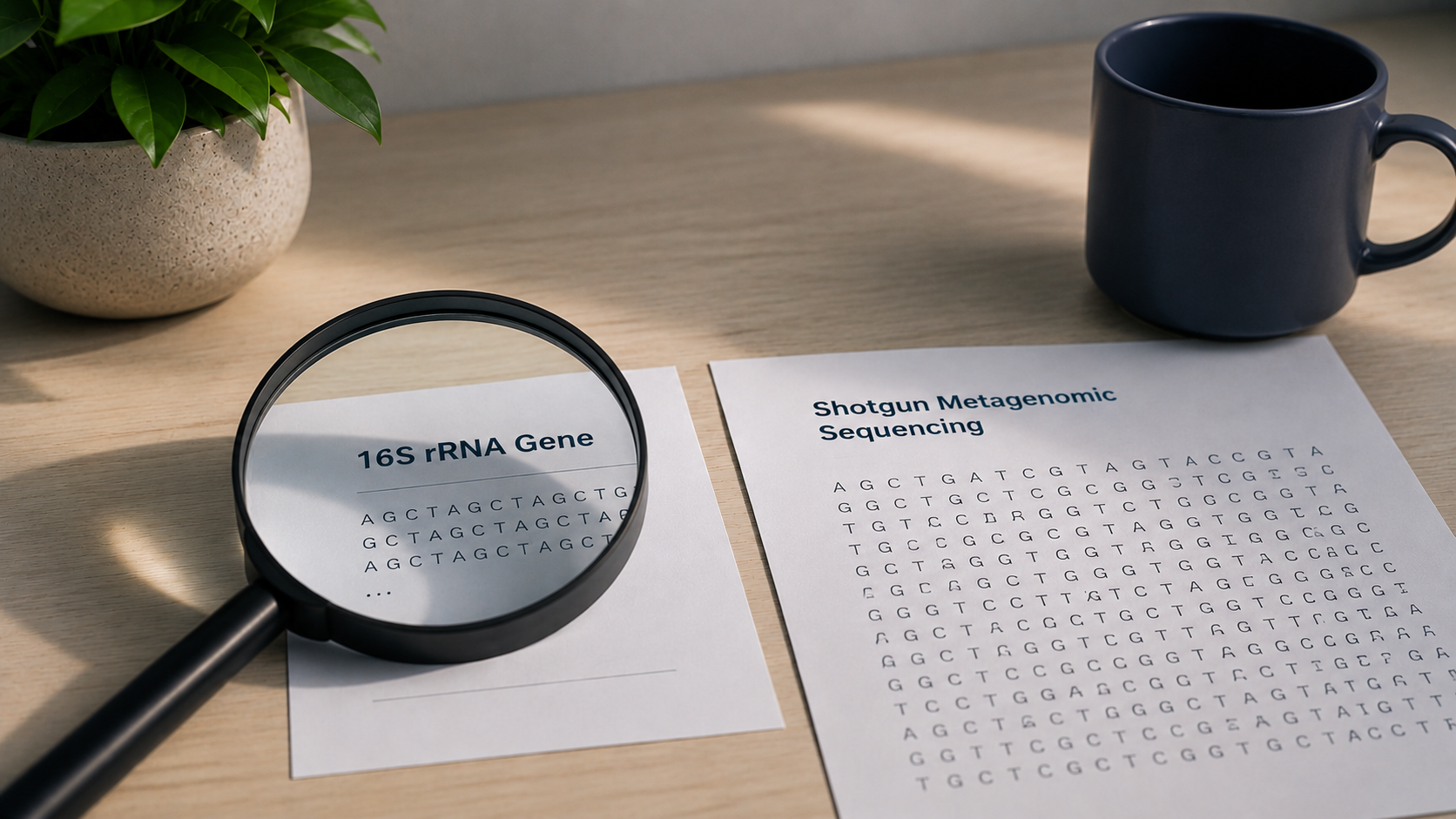
For years, 16S sequencing played a major role in microbiome research. It helped scientists explore bacterial communities in ways that were previously difficult, expensive, or impossible. Many early discoveries linking the gut microbiome to human biology were built on 16S-based studies¹.
But microbiome science has evolved rapidly.
Modern sequencing technologies now allow researchers to investigate the microbiome at a much deeper level and increasingly, many scientists are moving beyond traditional 16S approaches toward broader metagenomic methods like shotgun sequencing.
That does not mean 16S is “bad” or obsolete. It still has important uses in research. But when scientists want higher resolution, broader ecosystem analysis, and deeper functional insights, newer technologies are becoming increasingly important.
Here are five major reasons why modern microbiome research is moving beyond 16S sequencing.
1. The Microbiome Is More Than Just Bacteria
One of the biggest limitations of 16S sequencing is that it primarily focuses on bacteria.
But the gut microbiome is far more complex than bacterial communities alone².
Inside the gut ecosystem, researchers also study:
- fungi
- viruses
- bacteriophages
- archaea
- microbial interactions between these groups
Modern shotgun metagenomic sequencing can analyze much broader portions of the microbial ecosystem because it investigates the total DNA within a sample rather than only selected bacterial marker regions³.
This broader perspective is becoming increasingly important in microbiome science, where researchers now view the microbiome as an interconnected ecological network rather than a simple bacterial catalog.
2. Researchers Want Higher Resolution
Another major limitation of many 16S approaches is taxonomic resolution.
16S sequencing often identifies microorganisms mainly at the genus level. But different species within the same genus can behave very differently and may possess different metabolic properties, ecological roles, or microbial interactions⁴.
Modern shotgun sequencing frequently allows deeper resolution down to species-level classification.
This higher resolution helps researchers better understand:
- microbial diversity
- ecosystem composition
- subtle shifts within microbial communities
- interactions between specific microorganisms
As microbiome datasets become larger and more sophisticated, this level of detail is becoming increasingly valuable.
3. Modern Research Focuses More on Function
One of the most important shifts in microbiome science is the move from:
“What bacteria are present?”
toward:
“What can the microbiome actually do?”
This is where shotgun metagenomics becomes particularly powerful.
Because large portions of microbial DNA are analyzed, researchers can investigate functional genetic potential within the microbiome⁵.
This includes pathways related to:
- microbial metabolism
- short-chain fatty acid production
- gas production
- resistance-associated genes
- broader microbial ecosystem functions
This does not directly measure metabolites themselves, but it allows scientists to study the genetic potential behind microbial functions.
Increasingly, modern microbiome research is focusing not only on microbial identity, but also on microbial activity and ecosystem functionality.
4. The Human Gut Contains Millions of Microbial Genes
The human microbiome contains vastly more genetic material than the human genome itself⁶.
That realization fundamentally changed how scientists think about the gut ecosystem.
Traditional 16S approaches examine only a small bacterial marker region. Shotgun metagenomics, in contrast, can analyze much larger portions of microbial genetic information.
This allows researchers to investigate:
- broader microbial diversity
- microbial gene catalogs
- ecosystem complexity
- resistance-associated genes
- microbial evolutionary relationships
As sequencing technologies and bioinformatics continue improving, the ability to analyze these large microbial datasets has become one of the driving forces behind modern microbiome research.
5. Microbiome Science Is Becoming More Ecosystem-Oriented
Perhaps the biggest conceptual shift is how researchers now view the microbiome itself.
In the past, microbiome analysis often focused on individual bacterial groups in isolation. Today, many scientists increasingly approach the gut microbiome as a dynamic ecological system⁷.
Diet, stress, sleep, antibiotics, environment, host biology, and microbial interactions all continuously influence the microbiome.
This systems-level perspective requires broader datasets and more comprehensive sequencing approaches.
That is one reason shotgun metagenomics is becoming increasingly important:
it allows researchers to study the microbiome as a complex ecosystem rather than a limited bacterial snapshot.
Does This Mean 16S Is No Longer Useful?
Not at all.
16S sequencing remains valuable for:
- large cohort studies
- lower-cost exploratory projects
- broad bacterial community overviews
- certain ecological research questions
It is still widely used in microbiome science.
But as sequencing costs decrease and computational tools improve, modern microbiome research is increasingly moving toward more comprehensive metagenomic approaches.
The field is evolving from simple bacterial summaries toward deeper ecosystem-level analysis.
And that transition is reshaping how scientists study the human microbiome.
The Future of Microbiome Research
The microbiome field is still young. Many questions remain unanswered, and researchers continue refining how microbial ecosystems are studied and interpreted.
But one thing is becoming increasingly clear:
Future microbiome science will likely become:
- more data-rich
- more ecosystem-focused
- more function-oriented
- more computationally advanced
- more high-resolution
Modern sequencing technologies are opening entirely new ways to explore the microbial world inside us.
And we are still only beginning to understand its complexity.
Choosing the Right Technology Matters
Every sequencing method has its strengths, and 16S sequencing continues to play an important role in microbiome research. However, as researchers seek deeper insights into microbial ecosystems, shotgun metagenomics is becoming the preferred approach for studying the gut microbiome at higher resolution and with greater functional depth.
Understanding these differences helps researchers, healthcare professionals, and consumers make more informed decisions – for example, when choosing the best gut microbiome analysis.
Scientific References
- Johnson JS et al. Evaluation of 16S rRNA gene sequencing for species and strain-level microbiome analysis. Nat Commun. 2019.
- Huttenhower C et al. Structure, function and diversity of the healthy human microbiome. Nature. 2012.
- Quince C et al. Shotgun metagenomics, from sampling to analysis. Nat Biotechnol. 2017.
- Almeida A et al. A unified catalog of 204,938 reference genomes from the human gut microbiome. Nat Biotechnol. 2021.
- Lloyd-Price J et al. Multi-omics of the gut microbial ecosystem in inflammatory bowel diseases. Nature. 2019.
- Qin J et al. A human gut microbial gene catalogue established by metagenomic sequencing. Nature. 2010.
- Knight R et al. The microbiome and human biology. Annu Rev Genomics Hum Genet. 2017.
Share:
Why We Started Bactera: Why Most Microbiome Tests Still Miss the Bigger Picture
Leaky Gut: What Scientists Actually Agree On